Monday, September 13, 2021

The Serpent and the Seventies


    We're in Kanit House, a stylish yet shabby five-story apartment house in Bangkok in 1974. Balconies face a sun-drenched inner courtyard with a swimming pool where young hippie tourists from Europe and America share travel experiences, swim, get stoned, and listen to music. Alain Gautier, a suave dark-haired gem dealer wearing aviator glasses, stands on his balcony and watches the people frolicking below. He watches with purpose until he selects his prey. 

   Gradually, we come to recognize what he looks for: the vulnerable, reckless, needy, trusting. He studies them the way he studies jewels through his loupe, searching for genuine gems or fakes. Even before we learn what he's capable of, we sense danger. Even before he invites the unfortunate one to his room for a drink, and afterwards, coldly watches the person convulse in mysterious spasms. Even before we glimpse the man and his accomplice carrying the sick person down dark stairs. The following morning, there is one less hippie in Bangkok. But their money and passport remain-- to be stuffed in a safe with many other passports to be used later by the man and his two accomplices: Ajay, an Indian criminal, and Marie-Andrée Leclerc, a young French-Canadian woman.

    On the other side of town Herman Knippenberg, a young Dutch diplomat, Third Secretary in the Dutch Embassy in Thailand, studies newspaper reports of a couple who were knifed and set on fire while still alive. Although the couple is identified as Australian, the diplomat wonders if these two are the young Dutch man and woman who disappeared and whose parents called him to find out what happened. Knippenberg's investigation leads him down a dark and twisting path that uncovers the serpent's den and opens to an unimaginable web of horror that spans countries. 


                                                        Billy Howle as Herman Knippenberg

     The Serpent is a chilling, sinuous eight-part miniseries coproduced by BBC One and Neflix that reveals the world of the seventies as it tracks Charles Sobhraj, a real-life gem smuggler, escaped convict, and serial killer who preyed on backpackers on the Hippie Trail-- Bangkok, Kathmandu, Hong Kong, and Delhi. in the mid-seventies. He drugged and robbed countless people, and murdered at least twelve, and probably many more. Half-Vietnamese, half-Indian, he was raised in Vietnam, and later, in Paris. By the age of sixteen, he was in jail for petty crimes and theft. For the rest of his life, he'd be in and out of prison for increasingly violent crimes.
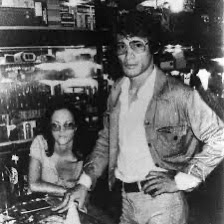
                                            The real Charles Sobhraj and Marie-Andrée Leclerc

    Sobhraj, played by actor Tahar Rahim, has nothing but contempt for these young drifters. He, Ajay, and Marie, now known as Monique, roam the Hippie Trail in search of victims. By observing how Sobhraj manipulates Monique, grooming her into his pimp luring potential victims to their room, we see how he manipulates everyone. A hollow man, he mimics human emotions, tests his followers' limits, demands utter obedience. Monique admits he turned her into a slave. Those who dare to challenge his authority or disagree with him are doomed. A vengeful god, he wants payback for every time he was mistreated for his mixed heritage. From The Guardian's review of The Serpent: "In the series, as in real life, he uses valid complaints about racism and neocolonialism to justify his crimes as a kind of revenge on the embodiment of careless white privilege." But the truth is he mistreats and abuses everyone who comes in his circle.

    Watching busloads of young tourists from Europe and America get off in Nepal and India is a revelation. They are mostly white, traveling to third-world countries with no sense of caution or danger. Disgusted with wars, capitalism, and society's rules, they've come to Asia to seek enlightenment, experience, community, drugs, and the meaning of life. In Slouching Toward Bethlehem, Joan Didion describes their mind-set: "drifting from city to torn city, sloughing off both the past and the future as snakes shed their skins." They are here to transform themselves.

    So is Sobhraj, who shifts his identity with each passport he steals, and with each person he encounters. Poor Knippenberg, back in Bangkok, tries to make sense of this chameleon and to follow his winding, dizzying trail. He must fight the indifference, hostility, and threats of the diplomatic community and local police who view these hippie tourists as disposable. No one cares to investigate their disappearances, no matter how suspicious they are. In addition, at that time, there exists no powerful DNA analysis, and police departments in different countries barely communicate. The world was a playground for serial killers. 

    If you weren't alive pre-cell phones and internet, pre-social media updates and CCTV, it may be difficult to imagine how different the world was. How private you could be. How possible it seemed to attain true solitude and freedom. For those who went on the Hippie Trail in the seventies, their only contact with the people back home was the weekly mail pick-up. If you wanted to drop off the face of the earth for a while, you could. 

     Why can't I stop thinking about this show? I've just finished writing Zigzag Girl, my first crime novel, in which an amateur sleuth confronts a serial killer. My sleuth lives in the 21st century and has the advantages of modern technology. She searches the web for clues, and she carries her cell phone, but she still must face the heart of evil. I've been thinking a lot about the monster that hides behind a human face, the inner rage that simmers and eventually explodes in violence. Sobhraj's cool mask hides the seething fury inside him.

But it's more than that. The show is brilliantly constructed: Knippenberg-- the force of light-- attacks Sobhraj-- the force of darkeness-- without ever meeting him. Knippenberg forms his own small team to investigate: his intelligent wife, a courageous French neighbor in Kanit House who witnessed suspicious activities, and a jaded Belgian diplomat. He nearly loses his wife and his job, but he is driven by the pursuit of justice. The storyline jolts back and forth in time, showing us how Sobhraj has been robbing and murdering for years. It's depressingly clear that he will never stop, and more depressingly, that it's unlikely he will ever be caught. 

    By the third episode, we've seen what happens when Sobhraj gets angry, and we tremble for Dominique, a young Frenchman. Drugged and held captive by Sobhraj, Dominique struggles to escape with the help of the French neighbor. It's edge-of-your-seat suspense. The final episodes can be frustrating, but the task to capture a charismatic manipulator who shifts identities, freely crosses borders, bribes his way out of prison after prison, a man for whom everyone is prey, is gargantuan. Amazingly, he has met his match in the stubborn Dutch diplomat, a true hero. He cannot give up. In his words, Sobhraj "got inside me like some sort of tropical malaria." 

Thanks to Knippenberg's efforts, Interpol finally enters the case, and Sobhraj is arrested in India. That's not the end of him: he served 21 years in India, returned to Paris a free man in 1997, and in 2003, went back to Nepal, where he is now serving a life sentence. In yet another improbable twist, he married a young Nepalese woman, who, of course, claims he is innocent. But he is still in prison, and that is thanks to the efforts of one man. 

                                                The swimming pool at Kanit House        

   Despite the darkness at the center, The Serpent portrays a time of hope, innocence, and seeking, when the world seemed vast and uncharted, and adventure and knowledge waited around the corner. That may be why I'm ultimately so fascinated by the show. I'm haunted most by the image of the group gathered around the pool at Kanit House. Like all the young, they feel invincible. They dream of tomorrow-- the world they yearn to explore, the love they hope to find-- unaware that from his balcony, a man watches. For a terrifying moment I picture myself in that group. Don't look up! I want to tell them. Please, whatever you do, don't meet his eyes

    The show is dedicated to them.


Saturday, July 31, 2021

Remember Writing Letters?


I didn't keep a quarantine diary, but I wrote letters. 

During the pandemic my husband and I went on a nostalgia kick. We watched movies from the 70s and 80s, delighting in a time before cell phones and computers were widely used. In our isolation, we already cringed at crowd scenes, but we loved how personal and intimate the characters' worlds felt. People met in person rather than communicated on a phone, they wrote letters and missed important phone calls because they weren't home. It lasted for months, this yearning for a time before plague, a time that seemed more innocent, for a thriller that relied on human ingenuity rather than technology.

I began dreaming of letters I'd received and sent. Letters that changed lives, perfumed letters, witty letters I wished I'd kept, love letters that bared souls. I wrote new letters I didn't mail: to people I 'd lost touch with, people I'd never met but who intrigued me, those I'd met only once but who left an impact, historical figures, characters in my stories who puzzled or infuriated me, and old lovers.

Remember writing and receiving love letters? It was so much more than the words on the page. First, the scribbled rough drafts. The careful selection of pen and paper-- oh God, remember stationery? The torment of writing the letter-- finding the exact words that conveyed the message you wanted to communicate, stopping before you said too much.... If you were a girl, adding the faint trace of perfume before you sealed the envelope. Then the anxious wait for a response. Checking the mailbox, hourly sometimes. 

It wasn't just love letters, it was letters themselves-- those mysterious missives from somewhere else, exotic stamps from different countries, the suspense of opening the envelope. Handwriting that revealed so much: impatient scrawl, precise printed letters, words that crawled uphill or diagonally across a page, back-tilted timid letters, misspellings before the days of auto-correct. A non-business typed letter brought its own set of questions: why so impersonal? is their handwriting that bad? what's the underlying message here? Then there were aerogrammes-- those wonderful thin blue sheets sent home from travels. You had to squeeze everything onto the side of one page. Unfolding them without tearing away part of the writing presented its own delicate challenge.  


At the height of the pandemic I taught a creative writing class on Zoom and described letters to my university students, all born in the 21st century. They sat in their little Hollywood Squares and stared, baffled, while I explained the art, passion, and power of writing and receiving letters. Replacing the shortcut of emojis with the search for the exact words to convey mood and intention. The built-in delay before pressing, "Send." The fact that you can keep them, concrete and solid memories. Once they figured out that letters went way beyond text messages and emails, I sensed a shift in mood. One young woman said with a sigh, "I wish I could get a love letter." Another said, "I want to write one, but I don't know who to send it to."

I decided to give them an assignment: write a letter to someone far away and tell them something you can't tell them in person. You can make it up or make it real. You can send it or keep it. But write a letter with a pen on paper (on paper? with a pen?!). Bring it to class. You can share the letter or not.

They shared them. Amazing to listen to 19 - 21 year-olds read letters they'd written by hand... on Zoom. 
The letters were moving, funny, heartwarming, and tender, and often illustrated with drawings. I thought, plague or not, we're still here, still the same yearning hearts and souls straining to connect. 

Afterwards a few students thanked me for the introduction to letter writing. 

I feel like a visitor from another planet. What can I show them next? Ah! I know. That inscrutable monolith of power that sat grimly silent for hours while you watched and waited... and waited... for it to shrill to life. 


Wednesday, April 8, 2020

Why is this night different from all other nights?


According to some friends, every Jewish holiday can be summed up by one of two responses:

The King (Pharaoh, fill in the blank) tried to destroy us, we won/lost, let’s eat.”

That brings us to Passover, the eight-day holiday that commemorates the Exodus—the Jews’ flight from slavery in Egypt to a 40 year-long trek through the desert that led to the Promised Land. The metaphor of an entire nation of people journeying from slavery to freedom is so powerful it’s no wonder many groups and nations throughout history have borrowed this story, remade it in their image, and used it as a banner of hope when times are dark.

It’s an understatement to say that we’re living through dark times. I’ve hesitated to write about it and generalize in any way because I can’t presume to know under what conditions you are experiencing the plague. It’s so wildly different for all of us—except for the aura of uncertainty that clouds our thoughts and actions. Which brings me to the first of the 4 questions traditionally asked during the Passover seder, the ritual meal in which Jews remember (and in a sense, relive) the plagues suffered during the time they were slaves to the Pharaoh and their subsequent escape:

Why is this night different from all other nights?

During the seder in 2020, the experience of naming the plagues and journeying from darkness to light will be different than it has ever been. For the first time, many of us will celebrate alone, away from family, and will rely on Zoom, FaceTime, and Skype to connect with family and friends scattered all over the world. For many of us this will be the first time we’ve lived through a plague and watched it destroy lives. For many of us it will be the first time we suffer from a virus that seems to have come from both the ancient world and a dystopian future.

Below is a passage from my first novel, The Road to Fez, in which a family celebrates Passover/Pesach in Morocco while trying to decide whether it’s safer to remain in Morocco or to take the chance and travel to Israel. Papa Naphtali is the American heroine’s grandfather, a mystic and musician who was inspired by the memory of my own grandfather:

“This is what Pesach means to me,” Papa Naphtali says. “It represents the most courageous, terrifying decision human beings have ever made, to leave a known life of slavery, and to enter the unknown, dangerous promise of freedom. They had to lose the habits of slavery, to learn to straighten their shoulders and to look strangers directly in the eyes. It took forty years of wandering in the desert before the first generation of slaves was gone, and the new generation born free and wild in the desert was ready to fight for the promise. Imagine the terror. Imagine looking over the rocks into the land you thought was a myth, and seeing that it was real, that you could touch the ground and smell the air. We’re always on the verge of freedom, but frightened to take that last step. So what will we do, mes enfants? Remain in the desert for another forty years? Or advance to the vision of light, which may be a mirage?”


Uncertainty may be the most frightening thing of all: we simply don’t know when, where, how this plague will end. We don’t know how long the quarantining/isolation will last. We don’t know what our post-Pandemic world will look like. It will certainly need to be navigated and explored as if we are entering a new country.

“Travelers’ reports differ as to what they saw when they entered the Promised Land. Bananas, oranges and pomegranates growing wild, or shimmering desert; a place of death, or one of life.”

Today is one of those dreamy days when I find myself voyaging to times I wandered freely: doing Sun Salutations at dawn on the Observation Deck of a ship, telling stories to my students on a lower deck of the ship as we sailed directly into the setting sun, digging at an archaeological site near Jerusalem (see photo), exploring a stage set on the Paramount lot in LA, or simply walking into a restaurant and hugging friends. More than anything, I miss hugs!

Each Passover, Jews are urged to relive this experience of plagues, exile, freedom as if we were the ones who lived through the first Passover. Each year we make it a time of reckoning for ourselves and our world: which plagues have we survived? What exiles are we suffering? How has our world changed? What does freedom mean to us? And each year, the traditional wish is: “Next year in Jerusalem.” This year, we may alter that wish to… wherever we hope to see ourselves next year.

Papa Naphtali says, “Time circles and returns to that endless moment in the desert. For the Jews, it’s always that moment. For us, it’s always now.”

And I circle back to the first question: there are many answers, most involving the Passover meal, the ritual foods and songs, the four glasses of wine, and the matzah, but for me, the answer to why this night is different from all other nights is because it returns us to the wanderers in the desert. They are us, and we are them. We have fled plagues, slavery, starvation, and thirst, and now we are poised on the edge of darkness. For a moment we stand together, remembering how it felt to press against each other in the uncertain darkness, before we take the next step, before we know whether it will bring more darkness or light.

That moment.

And then we take a deep breath, drink a glass of wine, and carry on toward the promise of the sun. One step at a time. I'll close with my favorite quote by Camus, a fellow North African:

"I realized, through it all, that in the midst of winter, I found there was, within me, an invincible summer. And that makes me happy. For it says that no matter how hard the world pushes against me, within me, there's something stronger – something better, pushing right back."


Thursday, March 12, 2020

Drinking Coffee (and Other Things) with Writers


During these strange times we're living in, the more we realize how important it is to connect with others. Today, I'm pleased to welcome Joyce Hinnefeld, a dear friend and writing sister with whom I've bonded over countless cups of coffee, to discuss how crucial these human connections are.

Take it away, Joyce!


I must have drunk a thousand cups of coffee with various writer friends through the years. In kitchens and living rooms in apartments and houses in New York and New Jersey and Pennsylvania. In countless Starbucks and Paneras. In a number of independent coffee shops that have come and gone in Pennsylvania’s Lehigh Valley. Drinking coffee and talking to other writers are two of my favorite things to do.

Usually, of course, we talk about projects we’re working on. There have been conversations about alternatives to traditional burial, the secret lives of magicians, feminist re-readings of the New Testament, working-class lives in New England mill towns, and more. I remember lots of helpful advice about my own work. To give a mother’s realization about her young adult daughter a physical manifestation—a gesture, a stirring in her daughter’s sleep. To dig further into a seemingly passive character, a young woman from the Pennsylvania coal region who won’t admit her deepest desires, even to herself. To keep an eye out for too many meandering, clause- and comma-filled sentences. (Like my previous one was, until—picturing the furrowed brow and raised eyebrows of a couple writers’ group members through the years—I broke it up into fragments.)

Every writer I’ve known has dreamed of having a Maxwell Perkins-style editor—brilliant, gentle, as fully invested in your work as you are as the writer. But writers today seldom have editors with the time and inclination to edit in that way. As a writer of books published by small presses, I’ve been fortunate to have smart and attentive editing—but my work has always traveled a long, circuitous route before landing on an editor’s desk. And fortunately, as it’s traveled along that winding route, it’s often landed, first, on the desks (or more recently the tablets) of trusted readers. Of friends who are also writers.

In my experience these friendships with writers might have begun in more formal writing workshops—at the 63rd Street YMCA in New York City many years ago, in graduate school at SUNY Albany in the early 1990s—but the lasting ones have continued well beyond that context, or, more recently, have emerged in other contexts. A colleague in the art department at the college where I teach has a party, where I meet a friend of a friend: a writer. A new writer is hired at the college in the next town over, and someone suggests I get in touch. A young writer, seeking a lower cost of living and more time to write, moves to the town that I never thought I’d call my hometown and asks if we can meet for coffee or a drink. And so it begins. (And what’s great about my friendship with that younger writer is that besides coffee we often go out for drinks—something I hardly ever do anymore!)

My relationships with writer friends now are markedly different from those I had with the people I knew in workshops; these writer friends have offered so much more than suggestions for a manuscript I’m struggling with. They’ve helped me negotiate the tricky challenges of being a writer and a parent. They’ve talked me down from my panicked terror over figuring out how to use social media to promote my work. And they’ve understood, and sympathized with, my frequent “fish out of water” feeling as a writer in an academic setting.

I’ve taught creative writing at a small liberal arts college in Bethlehem, PA for longer than I would have ever thought possible when I started the job back in 1997. These days I can’t believe I was fortunate enough to land such a job, and in an age of near contempt for the liberal arts and humanities, and of exploitation of contingent faculty, I know not to take this job for granted. I’ve been lucky in lots of ways, and one way in which I’ve been lucky has been in meeting young people, year after year, who are passionate about language, literature, and writing. Still. Even now.

It’s not easy to keep going with writing, when you’re often working long hours elsewhere to make rent and pay your bills. I know this, firsthand, from my former students. I miss our workshops, they sometimes tell me, when I run into them a few years after graduation. Find some writer friends, I tell them.

Six years ago I started a writers’ conference at the college where I teach. I must have been on drugs when I decided to do that, I’ve since told a number of people. But in fact I wasn’t on anything at all when I first conceived the sort of weirdly utopian vision I had for a conference that would, I hoped, help writers—of all ages, and at all levels of experience—find each other. And in many ways I think the Moravian College Writers’ Conference—scheduled to run for the fifth time at the end of March—has done just that.

I’m pleased about this of course. But I think the best thing the conference has given me is a chance to spend a day with some of my favorite people in the Lehigh Valley: other writers who live here and, in many cases, teach here. To join these writers in recognizing new talent, young and old, and in urging that talent to keep going with the work, no matter the limited prospects for publication, or for teaching jobs.

And to drink a lot of coffee together—even if it’s the coffee from the college catering department and, to be honest (don’t tell anyone I said this), it’s not very good.


Joyce Hinnefeld is the author of the short story collection Tell Me Everything and the novels In Hovering Flight and Stranger Here Below. Her new book, the story collection The Beauty of Their Youth (published this month), is the latest title in the Wolfson Press American Storytellers series. She is a Professor of English at Moravian College in Bethlehem, PA, where she directs the Moravian College Writers’ Conference. Learn more a www.joycehinnefeld.com and like her page at https://www.facebook.com/jhinnefeld/.

Wednesday, December 4, 2019

A Theory of Grace: guest post by Ethel Morgan Smith


Hope you all had a wonderful Thanksgiving holiday!

I spent a couple of weeks in November as a resident at VCCA, the Virginia Center for the Creative Arts, a truly wondrous home for the arts. I've been there many times, and each time, it's an amazing experience. While there, I worked on revisions for my novel-- still working on them-- and will tell you more about that soon. But I came home in time for Thanksgiving!

Today we welcome Ethel Morgan Smith to the blog. She will share an overview of her forthcoming book, A Theory of Grace: Voices & Visions of the Civil Rights Movement.

It sounds fascinating and relevant, and I look forward to reading it. Take it away, Ethel!

Ethel Morgan Smith


Theory of Grace tells us stories we’ve not heard before about The
Civil Rights Movement. The voices of the 10 individuals interviewed
offer more than personal stories; they afford a fresh historical
perspective. Their stories will move us, teach us, and take us on a
compelling journey. This work is dynamic and will raise new questions
about what it means to be human beings who seek justice against
tremendous resistance.
                                   

One narrow and prevailing view sees the TCRM in terms of Martin Luther King, Jr. 
and/or Rosa Parks, marching and making speeches. Many others consider that 
it ended with the Obama presidency. The TCRM is so much bigger and deeper than that.
It grew from intellectual and historical efforts; and it continues to
advance. The Movement is and was powered by mostly people like the
individuals I write about, ordinary citizens, stepping into big
moments by working behind the scenes, whether it was our teachers, our
parents having bake sales, or car washes to raise money for civil
right workers, or volunteers who helped with voter registration in our
churches and homes. This work expands the TCRM to the present and
future. Some of these brave warriors worked at the elbow of icons, and
others were clearing new paths, all passing through history without
wide recognition. The beauty of this book is the implied notion that
there were–and still are--thousands, and thousands more, each doing
their bit to achieve social justice for all. Theory of Grace
introduces us to some new witnesses and new voices that most people
haven’t heard. It takes a giant step forward toward negotiating the
narrative of a continuum of time periods, making it a work of social
change. And like the narrative that it is, it writes a new chapter in
history; a new culture is born.

We cannot talk about TCRM without visiting earlier movements that
began planting seeds of hope and freedom: slavery, Reconstruction, Jim
Crow, the Great Migration, WWI, and WWII. Many of my interviewees:
Emma Bruce, John Canty, Andrea Lee, Ann Cole Lowe, and Virginia
Blanche Franklin Moore, can trace their ancestry back to slavery,
which provides a direct chain of narrators. We will learn not only
about their contributions, but also about the extraordinary impact on
dozens of others. The book will view contemporary events, in all of
their catastrophic and challenging potential, through the lens of the
brave individuals who overcame equally extraordinary obstacles of the
past.

Ethel Morgan Smith is the author of two books: From Whence Cometh My Help: The African American Community at Hollins College and Reflections of the Other: Being Black in Germany. She has also published in The New York Times, Callaloo, African American Review, and other national and international outlets.


Wednesday, October 23, 2019

Guest Post: Footnotes on the Cutting Room Floor


A guest post today by Marlena Baraf, whose lovely, lyrical memoir about growing up Jewish in Panama, resonates deeply with all of us who--to use the title of one of my essays-- "live between question marks." Marlena writes:

"I love words that illustrate different perspectives. Hybrid. Hyphenated. Bilingual. Multicultural. Synthesis. They point to the richness possible with human groups."

I asked her about the stories she couldn't tell in her memoir, what she had to leave out....
Take it away, Marlena!


 My memoir, At the Narrow Waist of the World, is a mother-daughter story set in Panama that moves with me to the United States when I was fifteen. It began with a single scene. A memory of my mother under the calabash tree in our brick patio. She had just received shock therapy, “the sugar kind,” my uncle said, which referred to the use of insulin to induce shock treatment many years back. It’s an image I’d buried until it surfaced during a creative writing exercise. That scene opened the door to the story of my mother’s overwhelming anxiety that pushed away the fledgling love of her children.

There was always someone’s telling line, or a snapshot in my mind. Me as a five-year-old, waiting at the door for my father to arrive from work, feeling my heart soar like a pink, party balloon. My mother’s manicured hands placing tiny boxes of matches on the bridge table, her bracelets clinking as she set them down. I built the story on scenes, scenes with emotion--show not tell—because I felt that the real truth had to arrive unvarnished.

However. There is a “however,” of course. My story happened against the backdrop of a country few Americans know, the tiny Isthmus of Panama, within a family of Sephardic, Spanish-Portuguese Jews ensconced in Panama since the 1850s. Readers could not read my mind and all I knew. (How I wished they could!)  I had to provide grounding information.

I used scene and character--my great grandmother, Julita, a matchmaker of hearts--to tell the early family story. Through family legend about my wildly creative grandfather Jicky, I was able to comment on the building of the canal and the early life of Panama City. But some information did not fit within the roller coaster of my mother’s illness and the lyrical memoir that was taking shape.

In his novel, The Brief and Wondrous Life of Oscar Wao, Junot Diaz--feeling he had to ground readers in the story of the Dominican Republic and the 31-year rule of dictator Trujillo--provided extensive footnotes. It was a controversial move, and I had understood its necessity. I considered adding footnotes to my manuscript to catch the compelling facts I was uncovering.

In my book, I describe morning mass in the nun’s school I attended. In those years there were few options for Jewish children in Panama. About three years after I left Panama, two Argentine Azkenazi brothers arrived in Panama and founded the first Jewish school, open to all religions. My little brother went to “Einstein” as the new school was called--but that was long after my story. Many of my cousins and some Catholic children attended Einstein as well. This I felt was a sidebar, but an interesting one, to orient Jewish readers.

There were also details about the treatment of mental illness in Panama and the US in the 50s and 60s. I’d visited my mother at the Menninger Clinic in Topeka, Kansas. Father and son, Charles and Karl Menninger, are said to have introduced psychiatry to the United States. They railed against the conditions at asylum facilities in the mid-twentieth century and believed in providing psychiatric treatment in a humane environment, certain that people with chronic disorders (like my mother’s) could return to their families and lead productive lives.

I got advice from “beta readers.” One reported, “I love the footnotes. Why don’t you put them in the back of the book, so they don’t interrupt the flow.” Another reminded me of the nature of my memoir: textured and immediate. Footnotes might give it an “academic feel.” I wavered back and forth for months, and finally I decided. I wove into the narrative information I couldn’t bear to leave out. And I dumped the rest.

Here’s a scene from the memoir and the matching footnote that landed on the cutting room floor. In the book (on page 119) I’ve just returned home from college in the United States and traveling in a rickety train along the cinch belt that was the Canal Zone that cut through the narrow waist of Panama:
 “…It would be hot. My clothes would stick to me uncomfortably. The backs of the double seats inside the train would be shifted forward or back so that members of a family could face one another, though I’d be riding alone, looking past the open windows at swamps, tall grasses, and jungle—bamboo reeds sticking up in low-lying water—scenes that made me think of Vietnam, deep in my consciousness after a year of campus protests at Oxy.”

On the cutting room floor:
“At that very moment American soldiers were training for Vietnam in the jungles of Panama and in the towns I was crossing on that train ride home.”

The footnotes live in a Word file on my screen.

Marlena Maduro Baraf is a Jewish Latina who immigrated to the United States from her native Panama. Her work has been published in Ms. Magazine, Lilith, Lumina, Sweet, Huffington Post, and other publications. In past lives Marlena was book editor in New York City. She also studied at Parsons School of Design and the Writing Institute at Sarah Lawrence College. You can visit her at www.marlenamadurobaraf.com.