Once Upon A Time
Wednesday, October 12, 2022
Girl Meets Ghost: The Inspiration for I Scream Man
Wednesday, June 29, 2022
My Love Affair with Samba...
"'She came from Bahia, from centuries of dancing and sorrow…' Even that long-ago day in a darkened theater—the first time I heard samba—I knew there was no first time. My ears recognized the whispered words, my mouth tasted the sadness behind the joy, and my feet moved to the rhythm."
My love affair with samba began in that darkened theater years ago, and like all long love affairs, it sparked mysteries, surprises, and discoveries. Music of resistance, music for lovers, sensuous and hushed, it speaks in a whisper louder than a shout. It has been the soundtrack of my life: I've written, dreamed, danced to its rhythm.
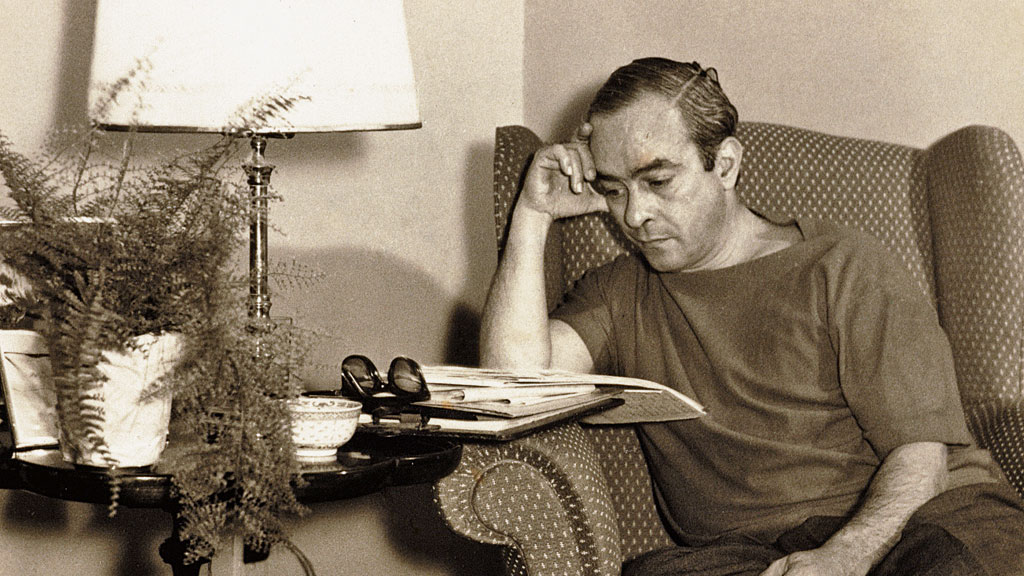
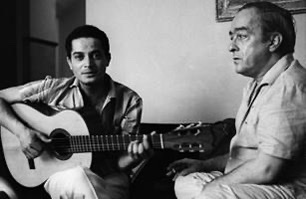
No one expressed the multitude of voices of samba more than the "Little Poet," Vinícius de Moraes.
Vinícius was my introduction to samba, and I knew that one day I'd need to travel to Brazil, and in particular, to Bahia, where samba was born-- and where he wrote some of his most influential music. The voyage itself was transcendent and transformative, as was the experience of writing an essay about it.
"A Mouthful of Sadness: Listening to Vinícius in Bahia" came out today in Off Assignment, and I'd like to share it with you. An interview follows the piece. Please follow the link:
https://mailchi.mp/offassignment/vinicius-in-bahia/
I'd love to know what you think, and if you've experienced similar voyages-- through the mind and the world-- that resulted in unexpected revelations.
Sarava!
Monday, March 14, 2022
Dreaming for a Living
I dream for a living. --Steven Spielberg
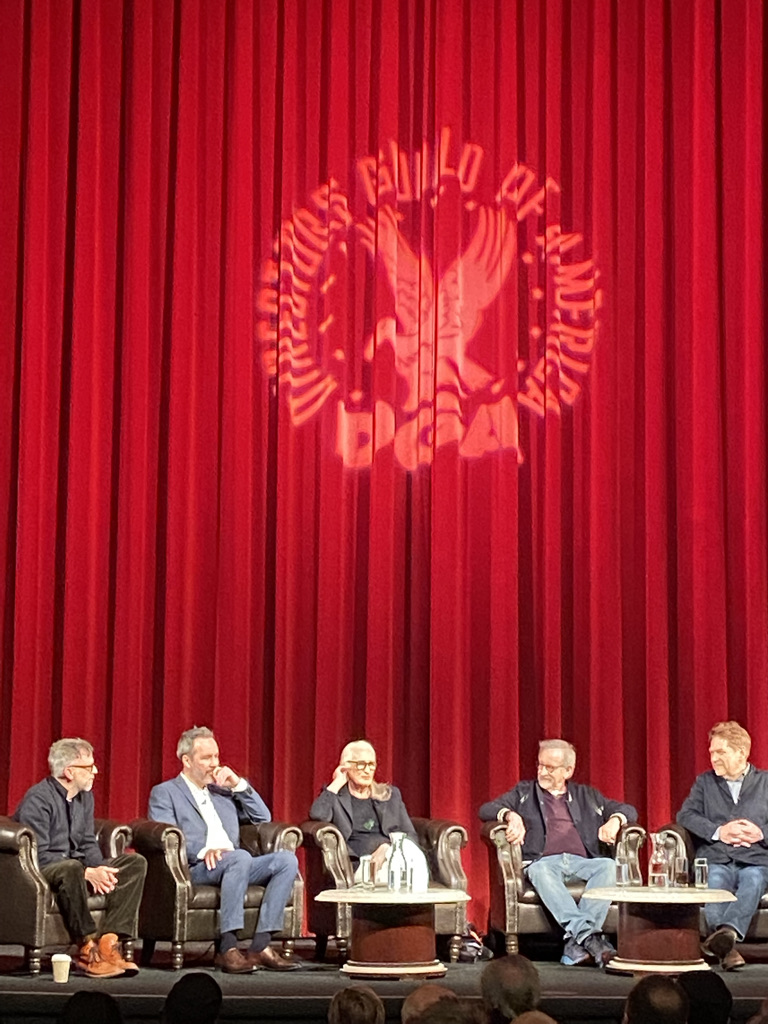
Thanks to my son, director/editor Ishai Setton, I was privileged to attend the all-star lineup at the DGA's roundtable with the five directors nominated for the 2022 Director's Guild of America Award: Paul Thomas Anderson, Denis Villeneuve, Jane Campion, Steven Spielberg, and Kenneth Branagh. For nearly three hours they answered moderator Jeremy Kagan's in-depth questions about their ways of creating new worlds on screen. It was interesting to note that all five nominated films-- Licorice Pizza, Dune, Power of the Dog, West Side Story, and Belfast-- take place in the past or in another universe. How did they bring these "foreign" worlds to life? How did they rehearse their actors? How do they deal with fear?
It was one of the most inspiring, fascinating panels I've ever attended. I was torn between taking notes and simply absorbing their words and insights. I found their observations very helpful as I'm in the process of creating a fictional world for a new novel. I've jotted down some takeaways that I hope you'll find useful in your own creations.
Steven Spielberg: the godfather of the group. Wise, witty, humble, at 75, a father of seven and grandfather of six, he was terrified when he began West Side Story, his first musical. The storyboarding process was critical to block the scenes and find the right setting. It was filmed mostly on a set in Paterson, NJ, and in Harlem. The biggest challenge: crosswalks and stoplights. They had to block them out after filming. He rode around the set, taking pictures with his iPhone, seeing the movie before filming.
A great example of how to think visually: The brilliance of the fire escape scene, which was modeled on the balcony scene of Romeo and Juliet. For Spielberg, the key was to keep the lovers apart. Tony just got out of jail, and as he tries to get to Maria, one obstacle after another confronts him. The difficulty is reflected in the lines and bars that shadow his progress as he breaks through to freedom. Musical numbers were filmed live. No over-dubbing in the studio.
His advice to actors: "Faster and funnier. Go faster than you think it should go." In the cutting room, the first things to go are the gaps and pauses in scenes, which you don't see until later.
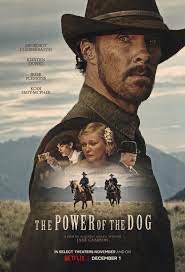
Jane Campion: The process of pre-production is the key to all the directors' films, but her route to the film was particularly interesting. Her script was adapted from the novel, Power of the Dog, by Thomas Savage, about two brothers on a ranch in Montana, but when she went scouting in Montana for the actual ranch, she discovered the land was not how she'd imagined it and there was no house. Writer Annie Proulx told her: "The West doesn't exist. It's a myth."
She returned to her native New Zealand and scouted locations there. Much cheaper. She had the house and barn built with special attention to interiors and space so when characters look out the window they feel the distance is right between the barn and the house.
She hit a block in terms of understanding her film and her story and underwent dream therapy. She described a recurrent dream she was having of herself on horseback--a horse she didn't know--riding down a path that grew narrower and narrower until she knew she'd fall of the horse at the end of the path--there was nowhere left to go--and she'd die. Through the therapy she understood that she needed to know the horse before riding it. She needed to know her characters and her story before filming. She talked to her characters and heard one of them say: "She's got to get dirty." Jane had to dive deep into her story in order to direct the characters and make this movie.
A fun tidbit: before filming the drunk scenes, Kirsten Dunst would spin in circles. Sometimes she'd have a small drink as well, Jane admitted with a laugh. Also-- Jane said that Benedict Cumberbatch is such a sweet, helpful man that he played totally against character, and Kirsten would tease him constantly on the set, insisting that he wasn't "bad enough."
Denis Villeneuve: The key to filming Dune was in the storyboarding process. As a boy, Denis and his friend, Nicolas Kadima, mapped out storyboards for the film of Dune they hoped to make one day. During the planning for the movie, Denis and storyboard artist, Sam Hudecki, planned the visual progression of Dune. He forbade Hudecki to go on the internet or to look at previous depictions of the worlds of Dune, Denis wanted to return to the images he'd drawn as a kid. For him, "the key to the story is how you interpret it through images."
While Spielberg admits he doesn't rehearse his actors-- "The first take is the rehearsal"-- Villeneuve talks to his actors, one on one, long personal conversations before shooting, during which they privately explore the actor's thoughts and ideas about the character. "I need to understand who is in front of me," he said. He admitted that getting high on "spicy" banana bread his son baked helped him describe his vision of scenes to actor Timothée Chalamet. "Timothée got it," said Denis.
About fear: "Always. I am always afraid." He's now working on the second part of Dune, and when people ask him on set what to do next or how to solve a certain problem, he no longer pretends he knows. He admits, "I don't know."
Kenneth Branagh: a marvelous storyteller, talked about recreating the world of his childhood in Belfast through the eyes of a nine-year-old boy. "Your imagination expands to fill the vacuum," he said, when he looked back at the small flat he'd lived in with his family and how vast with possibility it had appeared. In Belfast, he tried to recreate that sense of promise, danger, and wonder of that time.
He also spoke about his awe of the great Judi Dench who plays the boy's grandmother. He wanted to show the love between Judi Dench and Ciarán Hind, who plays her husband in the film. Ciarán read her a short romance story in "that glorious voice." After he left the room, Judi looked at Branagh, her eyes sparkling, and said, "I'm in love with him."
About being a director: he asked Annette Bening about the most important characteristic a director can have. She told him, "It's not sexy, but being organized is crucial." He has kept that in mind with every film. To be as precise and clear as possible. To prepare before the filming. All that work beforehand frees the director, the actors and the crew during the actual shoot.
Paul Thomas Anderson: He described driving from his home in Tarzana to drop off his daughter at school in Studio City, and on the return trip scouting locations for Licorice Pizza. "The Valley hasn't changed that much," he said. He found the actual waterbed store he remembered though the store sells something else now.
He recalls the experience of working "through the Covid of it all." And the extensive preproduction process. For him, it involved driving to the locations with two partners and filming scenes on his iPhone, mapping out the entire movie before shooting. He explained, "It's a mix of attack--telling the story a certain way that you have in mind, and accept--working with what's in front of you." A mix of planning and improvisation, always staying open to the moment.
He had the whole auditorium laughing when he said, "Working with teens, you realize that the real shooting starts at 3:30 in the afternoon, when they're finally awake."
Later that evening, during the awards ceremony held by the DGA, Denis Villeneuve admitted that as a boy in Canada, it was a tradition to wear a hockey jersey with your hero's name on the back. He put the name "Spielberg" on his jersey. He spoke to a visibly moved Spielberg:
“Mr. Spielberg, you are a giant for me. I am here tonight because of you. I thank you from the bottom of my heart of what you’ve brought and what you still bring to this day to cinema. After all these years, you are still a pure source of inspiration, so sir, I salute you.”
Jane Campion won the best director award for Power of the Dog, and in her acceptance speech, said:
"The road here has been long. I remember being the only woman in the room. I remember that outsider feeling as I fought to get my stories told from undeserved perspectives to light in a male-dominated field.”
Campion then added to loud applause, “I think perhaps it’s time to claim a sense of victory on that front. We’ve come so far, and what’s more, we’re never going backwards. That sense of the eternal horizon invigorates me.”
That sense of the eternal horizon is evident in all five directors--seasoned, experienced, brilliant-- yet always looking for the next project, the next challenge, the next world to share with us.
Monday, September 13, 2021
The Serpent and the Seventies
We're in Kanit House, a stylish yet shabby five-story apartment house in Bangkok in 1974. Balconies face a sun-drenched inner courtyard with a swimming pool where young hippie tourists from Europe and America share travel experiences, swim, get stoned, and listen to music. Alain Gautier, a suave dark-haired gem dealer wearing aviator glasses, stands on his balcony and watches the people frolicking below. He watches with purpose until he selects his prey.
Gradually, we come to recognize what he looks for: the vulnerable, reckless, needy, trusting. He studies them the way he studies jewels through his loupe, searching for genuine gems or fakes. Even before we learn what he's capable of, we sense danger. Even before he invites the unfortunate one to his room for a drink, and afterwards, coldly watches the person convulse in mysterious spasms. Even before we glimpse the man and his accomplice carrying the sick person down dark stairs. The following morning, there is one less hippie in Bangkok. But their money and passport remain-- to be stuffed in a safe with many other passports to be used later by the man and his two accomplices: Ajay, an Indian criminal, and Marie-Andrée Leclerc, a young French-Canadian woman.
On the other side of town Herman Knippenberg, a young Dutch diplomat, Third Secretary in the Dutch Embassy in Thailand, studies newspaper reports of a couple who were knifed and set on fire while still alive. Although the couple is identified as Australian, the diplomat wonders if these two are the young Dutch man and woman who disappeared and whose parents called him to find out what happened. Knippenberg's investigation leads him down a dark and twisting path that uncovers the serpent's den and opens to an unimaginable web of horror that spans countries.
Billy Howle as Herman Knippenberg
The Serpent is a chilling, sinuous eight-part miniseries coproduced by BBC One and Neflix that reveals the world of the seventies as it tracks Charles Sobhraj, a real-life gem smuggler, escaped convict, and serial killer who preyed on backpackers on the Hippie Trail-- Bangkok, Kathmandu, Hong Kong, and Delhi. in the mid-seventies. He drugged and robbed countless people, and murdered at least twelve, and probably many more. Half-Vietnamese, half-Indian, he was raised in Vietnam, and later, in Paris. By the age of sixteen, he was in jail for petty crimes and theft. For the rest of his life, he'd be in and out of prison for increasingly violent crimes.
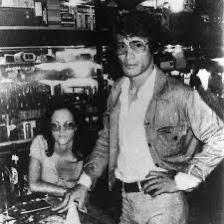
The real Charles Sobhraj and Marie-Andrée LeclercSobhraj, played by actor Tahar Rahim, has nothing but contempt for these young drifters. He, Ajay, and Marie, now known as Monique, roam the Hippie Trail in search of victims. By observing how Sobhraj manipulates Monique, grooming her into his pimp luring potential victims to their room, we see how he manipulates everyone. A hollow man, he mimics human emotions, tests his followers' limits, demands utter obedience. Monique admits he turned her into a slave. Those who dare to challenge his authority or disagree with him are doomed. A vengeful god, he wants payback for every time he was mistreated for his mixed heritage. From The Guardian's review of The Serpent: "In the series, as in real life, he uses valid complaints about racism and neocolonialism to justify his crimes as a kind of revenge on the embodiment of careless white privilege." But the truth is he mistreats and abuses everyone who comes in his circle.
Watching busloads of young tourists from Europe and America get off in Nepal and India is a revelation. They are mostly white, traveling to third-world countries with no sense of caution or danger. Disgusted with wars, capitalism, and society's rules, they've come to Asia to seek enlightenment, experience, community, drugs, and the meaning of life. In Slouching Toward Bethlehem, Joan Didion describes their mind-set: "drifting from city to torn city, sloughing off both the past and the future as snakes shed their skins." They are here to transform themselves.
So is Sobhraj, who shifts his identity with each passport he steals, and with each person he encounters. Poor Knippenberg, back in Bangkok, tries to make sense of this chameleon and to follow his winding, dizzying trail. He must fight the indifference, hostility, and threats of the diplomatic community and local police who view these hippie tourists as disposable. No one cares to investigate their disappearances, no matter how suspicious they are. In addition, at that time, there exists no powerful DNA analysis, and police departments in different countries barely communicate. The world was a playground for serial killers.
If you weren't alive pre-cell phones and internet, pre-social media updates and CCTV, it may be difficult to imagine how different the world was. How private you could be. How possible it seemed to attain true solitude and freedom. For those who went on the Hippie Trail in the seventies, their only contact with the people back home was the weekly mail pick-up. If you wanted to drop off the face of the earth for a while, you could.
Why can't I stop thinking about this show? I've just finished writing Zigzag Girl, my first crime novel, in which an amateur sleuth confronts a serial killer. My sleuth lives in the 21st century and has the advantages of modern technology. She searches the web for clues, and she carries her cell phone, but she still must face the heart of evil. I've been thinking a lot about the monster that hides behind a human face, the inner rage that simmers and eventually explodes in violence. Sobhraj's cool mask hides the seething fury inside him.
But it's more than that. The show is brilliantly constructed: Knippenberg-- the force of light-- attacks Sobhraj-- the force of darkeness-- without ever meeting him. Knippenberg forms his own small team to investigate: his intelligent wife, a courageous French neighbor in Kanit House who witnessed suspicious activities, and a jaded Belgian diplomat. He nearly loses his wife and his job, but he is driven by the pursuit of justice. The storyline jolts back and forth in time, showing us how Sobhraj has been robbing and murdering for years. It's depressingly clear that he will never stop, and more depressingly, that it's unlikely he will ever be caught.
By the third episode, we've seen what happens when Sobhraj gets angry, and we tremble for Dominique, a young Frenchman. Drugged and held captive by Sobhraj, Dominique struggles to escape with the help of the French neighbor. It's edge-of-your-seat suspense. The final episodes can be frustrating, but the task to capture a charismatic manipulator who shifts identities, freely crosses borders, bribes his way out of prison after prison, a man for whom everyone is prey, is gargantuan. Amazingly, he has met his match in the stubborn Dutch diplomat, a true hero. He cannot give up. In his words, Sobhraj "got inside me like some sort of tropical malaria."
Thanks to Knippenberg's efforts, Interpol finally enters the case, and Sobhraj is arrested in India. That's not the end of him: he served 21 years in India, returned to Paris a free man in 1997, and in 2003, went back to Nepal, where he is now serving a life sentence. In yet another improbable twist, he married a young Nepalese woman, who, of course, claims he is innocent. But he is still in prison, and that is thanks to the efforts of one man.
The swimming pool at Kanit HouseDespite the darkness at the center, The Serpent portrays a time of hope, innocence, and seeking, when the world seemed vast and uncharted, and adventure and knowledge waited around the corner. That may be why I'm ultimately so fascinated by the show. I'm haunted most by the image of the group gathered around the pool at Kanit House. Like all the young, they feel invincible. They dream of tomorrow-- the world they yearn to explore, the love they hope to find-- unaware that from his balcony, a man watches. For a terrifying moment I picture myself in that group. Don't look up! I want to tell them. Please, whatever you do, don't meet his eyes.
The show is dedicated to them.
Saturday, July 31, 2021
Remember Writing Letters?
Wednesday, April 8, 2020
Why is this night different from all other nights?

Thursday, March 12, 2020
Drinking Coffee (and Other Things) with Writers
During these strange times we're living in, the more we realize how important it is to connect with others. Today, I'm pleased to welcome Joyce Hinnefeld, a dear friend and writing sister with whom I've bonded over countless cups of coffee, to discuss how crucial these human connections are.
Take it away, Joyce!